

The Global Financial Crisis (GFC) was one of the most severe financial and economic shocks of the modern era. It began with problems in the US housing and mortgage markets but quickly spread through banks, investment firms, credit markets and economies around the world.
The crisis was not caused by one event. It developed from a combination of subprime lending, excessive borrowing, high leverage, risky financial products, rising house prices, weak risk management and regulatory shortcomings. When US house prices started falling and borrowers began defaulting, losses moved through the financial system with surprising speed.
The result was a major banking crisis, financial market panic and global recession. In the United States, the recession officially lasted from December 2007 to June 2009, according to the National Bureau of Economic Research (NBER).
What Was the Global Financial Crisis? ( Stock Market Crash In 2008 )
The Global Financial Crisis was a worldwide financial shock that became particularly severe during 2007 and 2008 and was followed by a deep economic downturn.
At its center was the US housing market. During the preceding housing boom, lenders extended large numbers of mortgage loans, including loans to subprime borrowers with weaker credit profiles. These mortgages were increasingly packaged into mortgage-backed securities (MBS) and sold to investors.
As long as house prices continued rising, many problems remained hidden. But when house prices fell, borrowers struggled to refinance or sell their homes, defaults increased and the value of mortgage-related financial securities declined.
The crisis then moved beyond mortgages.
Banks and other financial institutions faced losses, short-term funding became harder to obtain, investors lost confidence and credit markets became severely stressed. The failure of Lehman Brothers on September 15, 2008 became one of the defining moments of the crisis.

What Caused the Global Financial Crisis?
There were several interconnected causes rather than a single trigger.
1. The US Housing Boom Became Unsustainable
The US housing market expanded rapidly during the early 2000s. House prices increased, mortgage credit became easier to obtain and lenders competed aggressively for borrowers.
This created a powerful feedback loop:
More mortgage lending → stronger housing demand → higher house prices → more borrowing → greater expectations of future price increases.
The problem was that some of the growth depended on increasingly risky borrowing.
The Federal Reserve’s historical analysis notes that the expansion of mortgages to high-risk borrowers occurred alongside rapidly rising home prices and contributed to the subsequent financial turmoil.
When house prices stopped rising, the logic supporting the boom began to reverse.
2. Subprime Lending Increased Default Risk
Subprime lending refers broadly to lending to borrowers considered higher risk because of factors such as weaker credit histories or limited ability to make large down payments.
Subprime loans were not automatically destined to fail. The bigger problem was the scale at which mortgage credit was expanded and the way risks were distributed throughout the financial system.
Some mortgage borrowers eventually found themselves unable to keep up with loan repayments. Once defaults increased, lenders and investors began suffering financial losses.
The deterioration accelerated after housing prices stopped supporting refinancing and home sales as an easy way to repay mortgage debt.
3. Mortgage-Backed Securities Spread Housing Risk
One important feature of the period was the growth of mortgage-backed securities, or MBS.
Instead of simply keeping mortgage loans on their balance sheets, lenders could pool mortgages and turn them into financial securities. These securities could then be sold to investors.
This process provided lenders with more funding and allowed investors around the world to gain exposure to the US housing market.
But it also created a major problem: housing risk became embedded in financial markets far beyond individual mortgages.
When mortgage defaults increased and house prices fell, the value of mortgage-related securities became difficult to assess. Financial institutions began questioning the quality of assets held by other institutions, contributing to a broader loss of confidence.
4. Banks and Investors Used Too Much Leverage
Another major weakness was financial leverage.
Banks and investment firms had substantial exposure to financial assets while relying heavily on borrowed money and short-term funding. Leverage can increase returns when asset prices rise, but it can also magnify losses when prices fall.
This meant a relatively moderate decline in the value of certain assets could create disproportionately large losses for highly leveraged institutions.
The problem became particularly dangerous when lenders and investors became unwilling to provide short-term financing.
A liquidity problem could therefore become a solvency problem.
5. Risk Management and Regulatory Oversight Were Inadequate
The crisis also exposed weaknesses in financial regulation, banking regulation and regulatory oversight.
Some financial institutions underestimated the possibility that housing prices could fall nationwide and that mortgage-related losses could spread across interconnected markets.
The post-crisis Dodd-Frank legislation was designed in part to address weaknesses involving financial supervision, capital, risk management and systemic risk. It was signed into law on July 21, 2010.
This does not mean regulation alone caused the crisis. Rather, the crisis reflected an interaction between incentives, lending practices, leverage, financial innovation, risk management and regulatory shortcomings.
How Did the Global Financial Crisis Unfold?
The crisis developed in stages.
Borrowers Started Missing Mortgage Payments
As house prices weakened, some homeowners could no longer refinance their mortgage loans on favorable terms.
Others owed more on their homes than the properties were worth.
As loan defaults and foreclosures increased, mortgage-related assets lost value.
The housing downturn also damaged the wider economy by reducing construction, weakening household wealth, restricting financial lending and making it harder for companies to raise money. Source: Acorns
Financial Institutions Came Under Pressure
Losses spread from mortgage lenders to banks, investment banks, insurance companies and investment funds.
Bear Stearns was acquired by JPMorgan Chase with Federal Reserve assistance in March 2008. Later that year, Lehman Brothers filed for bankruptcy, while AIG received government support.
Lehman Brothers Intensified the Panic
Lehman Brothers filed for bankruptcy on September 15, 2008.
The event intensified uncertainty across global financial markets. Investors became concerned about the financial health of other institutions and the safety of short-term credit markets.
The crisis was no longer simply a problem involving mortgages. It had become a systemic financial crisis.
The Crisis Spread Internationally
Global financial linkages meant that banks and investors outside the United States were also exposed to US mortgage-related assets and the broader deterioration in credit conditions.
As confidence fell, lending tightened and financial institutions became more cautious.
The result was financial contagion: stress originating in one market transmitted to other financial markets and economies.
What Were the Effects of the Global Financial Crisis?
The effects of the Global Financial Crisis extended far beyond Wall Street.
Major effects included:
- Large financial losses for banks and investors
- Falling house prices and increased foreclosures
- Severe stress in credit markets
- Reduced consumer spending
- Lower business investment
- Rising unemployment
- Bank failures and government interventions
- A major economic recession
- Weaker investor confidence
- Greater government involvement in financial markets
- Major changes to financial regulation
The US economy experienced an especially severe contraction. Federal Reserve History reports that US GDP fell by about 4.3% from peak to trough during the 2007–09 recession and that the unemployment rate more than doubled from below 5% to 10%.
2008 Stock Market Crash: What Happened?
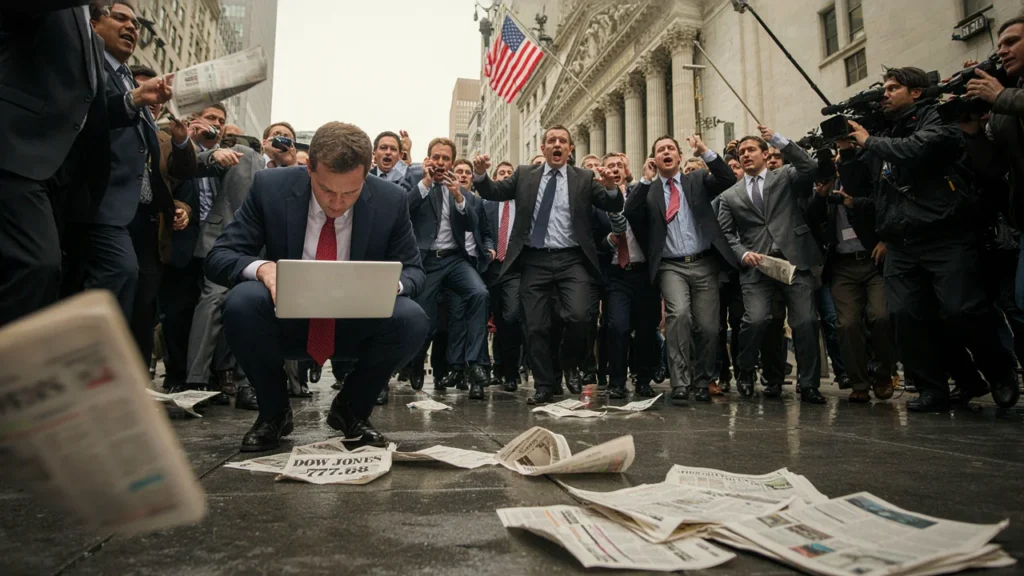
The stock market became a major channel through which investor fear was reflected in asset prices.
The S&P 500 recorded a total return of -37.00% in 2008, according to S&P Dow Jones Indices data. By comparison, its total return in 2023 was 26.29%.
2008 vs. 2023 S&P 500 comparison
| Year | S&P 500 price return | Total return |
|---|---|---|
| 2008 | -38.49% | -37.00% |
| 2023 | +24.23% | +26.29% |
The comparison is useful because it shows that 2008 was not simply an ordinary weak stock-market year. It occurred during a systemic financial crisis involving collapsing credit, failing institutions and severe economic stress.
By contrast, the S&P 500’s strong 2023 performance occurred in a very different financial and economic environment.
Important: a calendar-year return is not the same thing as the maximum peak-to-trough decline during a crisis. A stock market can experience a much larger temporary decline than its final annual return suggests.
How Did Governments Respond to the Financial Crisis?
Governments and central banks responded with a combination of monetary policy, emergency lending, fiscal measures and financial-sector support.
Central Banks Cut Interest Rates
The Federal Reserve aggressively lowered interest rates as the crisis intensified.
Its federal funds target fell from 5.25% in September 2007 to a range of 0% to 0.25% in December 2008.
Lower interest rates were intended to make borrowing cheaper, support demand and reduce pressure on the financial system.
Quantitative Easing Became Important
With short-term interest rates near zero, the Federal Reserve also purchased large quantities of longer-term securities, including Treasury securities and mortgage-backed securities.
These actions became known as quantitative easing (QE) and were intended to improve financial conditions and support economic activity.
Governments Provided Financial Support
Authorities also introduced programs designed to stabilize financial institutions and credit markets.
The US government supported certain institutions and created programs to address problems in the banking and financial system. The Federal Reserve also introduced emergency lending facilities during the crisis.
Financial Regulation Was Strengthened
The crisis resulted in major regulatory changes, most notably the Dodd-Frank Wall Street Reform and Consumer Protection Act of 2010.
The legislation introduced stronger requirements concerning capital, risk management and oversight of systemically important financial firms.
How Long Did the Great Recession Last?
The US Great Recession lasted from December 2007 to June 2009, or 18 months.
The NBER identifies December 2007 as the beginning and June 2009 as the trough that marked the end of the recession. It was the longest US recession since World War II at the time.
However, the end of a recession does not mean an immediate return to normal conditions.
Employment, household wealth, housing markets and credit conditions took considerably longer to recover. Federal Reserve History describes the recovery following the 2007–09 downturn as unusually slow.
What Happened After the 2008 Financial Crisis?
The aftermath changed both financial markets and financial regulation.
Banks generally faced greater attention to capital and liquidity. Regulators increased scrutiny of systemic risks, while central banks gained experience using unconventional monetary policy.
Households also experienced long-lasting effects through unemployment, lost wealth, foreclosures and tighter lending standards.
The crisis also changed how policymakers think about financial stability. A financial institution does not need to be a traditional commercial bank to create systemic risk if it is highly interconnected with other parts of the financial system.
Could Another 2008-Style Financial Crisis Happen?
Yes, another financial crisis is possible, but that does not mean another 2008 event is inevitable.
The exact combination that produced the GFC may not repeat itself. Financial institutions, regulators and policymakers learned important lessons from the crisis, and the regulatory framework changed significantly afterward.
However, financial risks can migrate.
A future crisis could emerge from a different combination of:
- Excessive leverage
- Asset-price bubbles
- Weak underwriting standards
- Liquidity shortages
- Concentrated exposures
- Rapid loss of investor confidence
- Problems in interconnected financial institutions
- Unexpected economic shocks
The key lesson is that financial stability depends not only on individual banks but also on the connections between banks, investors, markets and households.
Lessons From the Global Financial Crisis
The GFC provides several important lessons.
1. Rising asset prices do not eliminate risk
A long period of rising house prices can make borrowing appear safer than it really is.
2. Leverage can magnify losses
Borrowing can increase financial returns, but it can also turn falling asset prices into severe balance-sheet problems.
3. Liquidity matters
A financial institution can own valuable assets and still experience a crisis if it cannot obtain funding when it needs it.
4. Financial markets are interconnected
Mortgage problems in one part of the US housing market eventually affected financial institutions and economies around the world.
5. Regulation needs to consider systemic risk
Supervising individual institutions is not always enough. Regulators also need to understand how institutions and markets interact.
6. Confidence can change quickly
The crisis showed how rapidly investor confidence can disappear when participants become uncertain about losses and counterparties.
Global Financial Crisis FAQs
What caused the financial crisis of 2008?
The 2008 financial crisis was caused by a combination of factors, including excessive mortgage lending, subprime loans, rapidly rising house prices, high financial leverage, complex mortgage-backed securities, risky borrowing, weak risk management and regulatory shortcomings. When US house prices fell and mortgage defaults increased, losses spread through interconnected financial institutions and markets.
How much did the stock market crash in 2008?
The S&P 500 had a -37.00% total return in 2008, while its price return was approximately -38.49%.
What happened in the 2008 stock market crash?
The stock market fell sharply as the financial crisis intensified. Investors faced uncertainty about mortgage-related losses, bank solvency, credit availability and the broader economy. The September 2008 failure of Lehman Brothers intensified financial market panic and contributed to further selling pressure.
What is the 2008 stock market crash chart vs. 2023?
Using the S&P 500’s annual total return, the contrast is substantial:
- 2008: -37.00%
- 2023: +26.29%
These figures represent full-year total returns, not peak-to-trough market declines.
What is the 2008 stock market crash explained simply?
In simple terms, the US housing market experienced a major downturn after years of rapid mortgage and house-price growth. Mortgage defaults increased, mortgage-related securities lost value, financial institutions suffered losses and credit markets became stressed. The failure of major financial firms intensified panic, which then spread into the wider economy.
Read more…….