
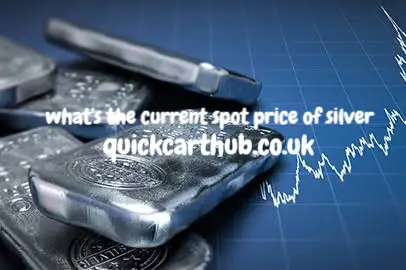
As of the latest verified Kitco quote retrieved on October 6, 2026, at 12:06 p.m. ET, silver was trading at $61.24 per troy ounce on the spot bid, with an ask price of $61.49. Kitco showed an intraday range of $60.16 to $61.83. Because silver trades continuously during global market hours, the exact live quote can change within seconds. what’s the current spot price of silver.
For a quick reference:
| Silver measurement | Latest quoted value* |
|---|---|
| Silver spot price per troy ounce | $61.24 |
| Silver price per gram | $1.97 |
| Silver price per kilo | $1,968.94 |
| Silver price per pennyweight | $3.06 |
| Silver price per tola | $22.97 |
| Silver price per tael | $74.42 |
| Silver spot bid | $61.24/oz |
| Silver spot ask | $61.49/oz |
| October 6 intraday range | $60.16–$61.83/oz |
*Quote shown as of 12:06 p.m. ET on October 6, 2026; market prices are continuously changing.
A useful distinction is that $61.24 is the market’s spot bid—not necessarily the price you will pay for a physical silver coin or bar. Dealers normally add premiums for fabrication, distribution, inventory, payment processing and other costs.
4. What Does the Silver Spot Price Mean?
The silver spot price is the benchmark market price used to value silver for near-immediate settlement or delivery. It is normally quoted in U.S. dollars per troy ounce, rather than per ordinary household ounce.
One troy ounce contains approximately 31.1035 grams. That is why a silver quote of about $61.24 per troy ounce translates to roughly $1.97 per gram.
The spot market is different from the price printed on a retail dealer’s website. If spot silver is $61.24, a one-ounce .999 silver round might sell for more because the buyer is paying for the physical product and the dealer’s operating costs.
There are also recognized benchmark prices. The LBMA Silver Price, administered independently by ICE Benchmark Administration, is established through a London auction once each working day at noon London time. It serves as an internationally recognized benchmark for silver delivered in London.
5. Silver Price Today: Why Does the Number Keep Changing?
Silver is a globally traded commodity, so its price responds to changing buying and selling pressure around the world.
Several factors can move the current silver price, including:
- U.S. dollar strength or weakness
- Interest-rate expectations
- Inflation expectations
- Treasury yields
- Investor demand
- Silver ETF flows
- Industrial consumption
- Mine production
- Recycling supply
- Geopolitical developments
- Gold-price movements
- Futures-market positioning
- Changes in physical inventories
Silver can also move more sharply than gold because it combines precious-metal investment demand with substantial industrial demand. CME Group notes that silver’s industrial applications make general economic and technology conditions particularly important to its price behavior.
6. How Much Is 1 Ounce of Silver Worth?
At the latest verified quote used in this article, one troy ounce of silver was worth about $61.24 at the spot bid.
That figure represents the value of the metal itself. The amount you receive when selling a physical coin or bar can be lower than spot, while the amount you pay to buy one can be higher.
For example:
Silver melt value = silver weight × purity × current spot price
A one-ounce .999 silver bar contains almost exactly one troy ounce of silver, so its theoretical metal value is close to the spot price. A sterling-silver object marked 925 contains 92.5% silver, so its theoretical silver content is substantially lower.
7. Silver Value by Purity
Silver is not always 99.9% pure. The metal’s fineness matters when calculating its intrinsic or melt value.
Using the $61.24 spot bid as an example, the approximate metal value per troy ounce is:
| Silver purity | Common description | Approx. metal value/oz |
|---|---|---|
| 9999 | .9999 fine silver | $61.30 |
| 999 | .999 fine silver | $61.18 |
| 925 | Sterling silver | $56.68 |
| 900 | 90% silver/coin silver | $55.12 |
| 800 | 80% silver | $48.99 |
These are theoretical metal values, not guaranteed retail or resale prices. A finished piece can have a collectible, artistic or jewelry value that is higher than its melt value.
What does .999 fine silver mean?
.999 fine silver means the metal is 99.9% silver. It is a common purity for investment-oriented silver bars and many bullion coins.
What is sterling silver?
Sterling silver is 92.5% silver, commonly marked 925. The remaining material is generally another metal, often copper, added to improve durability.
That means a sterling item weighing 100 grams does not contain 100 grams of pure silver. Its theoretical pure-silver content is approximately 92.5 grams before accounting for manufacturing details, stones, clasps or other non-silver components.
8. Spot Price vs. Silver Futures Price
The spot price and silver futures price are related but are not identical.
The spot market reflects pricing for silver associated with near-term delivery or settlement, while a futures contract establishes a price for delivery or settlement at a specified future date.
On COMEX, the standard silver futures contract represents 5,000 troy ounces of deliverable silver. CME Group also offers smaller silver futures products for market participants seeking different contract sizes.
The futures market is important because it provides liquidity and price discovery. Futures prices can trade above or below the spot market depending on factors such as interest rates, financing costs, inventories, expectations and market positioning.
This is why a headline showing the COMEX silver futures price should not automatically be described as the exact physical silver spot price.
9. What Is Moving Silver Prices in 2026?
The silver market in 2026 has been unusually volatile.
Silver reached a reported record of $121.60 per ounce on January 29, 2026, according to Reuters, before falling more than 25% the following day. By early October, silver had moved back toward the $60-per-ounce area.
That history is important for anyone looking at a silver price forecast. A large rally does not automatically mean prices will continue rising at the same rate.
Current market conditions reflect competing forces.
The Silver Institute’s 2026 outlook expects the global silver market to remain in deficit for a sixth consecutive year. It forecasts total supply of about 1.05 billion ounces and mine production of roughly 820 million ounces. At the same time, physical investment is projected to increase 20% to about 227 million ounces.
Industrial demand is more complicated. The Silver Institute’s World Silver Survey 2026 estimates industrial demand fell 3% in 2025 to 657.4 million ounces and forecasts another 3% decline in 2026, largely because solar manufacturers are using less silver per unit and increasingly substituting other materials.
That creates an important nuance: rising solar installations do not necessarily translate into proportionally rising silver demand if manufacturers continue reducing the amount of silver used in each solar cell.
At the same time, applications involving electronics, automobiles, power infrastructure, artificial intelligence and data centers continue to provide potential sources of structural industrial demand.
10. Why Does Industrial Demand Matter So Much for Silver?
Silver has properties that make it useful beyond jewelry and investment.
Its electrical and thermal conductivity makes it valuable in:
- Electronics
- Electrical contacts
- Solar photovoltaic technology
- Automotive systems
- Power infrastructure
- Brazing and soldering
- Some chemical catalysts
- Other industrial applications
The Silver Institute expects technology-related applications such as solar, electric vehicles, data centers and AI infrastructure to remain important to silver demand over the longer term, even as manufacturers work to reduce silver use in some applications.
This industrial exposure can make silver behave differently from gold. Gold is predominantly a monetary, investment and jewelry metal, while silver has a much stronger connection to manufacturing activity.
11. The Gold-Silver Ratio Today
The gold-silver ratio measures how many troy ounces of silver are required to buy one troy ounce of gold.
The calculation is simple:
Gold price ÷ silver price = gold-silver ratio
Using prices around October 6, 2026, market data placed the ratio near 68 ounces of silver for one ounce of gold.
The ratio is useful as a relative-value indicator, but it should not be treated as a standalone silver price forecast.
For example, if gold rises while silver remains unchanged, the ratio increases. If silver rises faster than gold, the ratio falls.
12. Silver Price History and the 2026 Record
Silver has a long history of dramatic price movements, including periods of speculative buying and sharp corrections.
The 2026 surge provides a particularly clear example. Reuters reported that silver reached $121.60 per ounce on January 29, 2026, followed by an exceptionally rapid selloff.
This means today’s price should be considered within a much wider historical range rather than viewed in isolation.
Historical prices are useful for understanding:
- Long-term volatility
- Previous bull and bear markets
- Inflation-adjusted performance
- The relationship between gold and silver
- The effect of industrial cycles
- The impact of speculative demand
However, past silver price performance cannot guarantee future results.
13. Silver as an Investment: Coins, Bars and ETFs
Investors can obtain silver exposure in several ways.
Physical silver
Common forms include:
- Silver bars
- Silver bullion coins
- Rounds
- Junk or constitutional silver
Physical silver gives the owner direct possession of the metal but also introduces storage, insurance, security and transaction considerations.
Silver ETFs
Exchange-traded products can provide exposure to silver prices without requiring investors to store bars or coins themselves. However, investors should understand the product’s structure, fees, tracking characteristics and risks before investing.
Silver mining companies
Shares of silver-mining companies provide equity exposure rather than direct ownership of silver. Mining companies can be affected by silver prices, but also by operating costs, energy prices, labor, management decisions, political conditions and mine-specific risks.
The SEC’s Investor.gov emphasizes that investment products have different risks and costs and that investors should understand those risks before investing.
14. What Is Junk Silver?
In the United States, junk silver is a common market term for older circulated coins whose value is primarily based on their silver content rather than rarity.
Many U.S. dimes, quarters and half dollars dated 1964 or earlier were made with 90% silver. The Coinage Act of 1965 changed the composition of circulating U.S. coinage, removing silver from dimes and quarters and reducing the silver content of half dollars.
Collectors should be careful, however, because not every old silver-colored coin has the same composition, and rare dates or varieties can be worth substantially more than their melt value.
Before selling an old coin strictly for scrap or melt value, check whether it has numismatic value.
15. How Do You Calculate Silver Melt Value?
To estimate the melt value of ordinary silver:
Melt value = weight × purity × spot price
For a simple example, suppose you have 100 grams of sterling silver.
- Weight = 100 grams
- Purity = 92.5%
- Pure silver content = 92.5 grams
- Multiply the pure silver weight by the current silver price per gram.
At approximately $1.97 per gram, the theoretical silver content would be around $182 before considering dealer spreads, refining costs, condition, workmanship or collectible value.
A silver melt value calculator can automate this process, but the result is only as accurate as the weight, purity and spot price entered.
source: jmbullion.com
16. What Is the Silver Price Forecast?
There is no single reliable number that can tell investors where silver will trade next.
A useful silver price forecast should consider several competing variables:
Bullish influences may include:
- Persistent physical-market deficits
- Strong investment demand
- Lower interest rates or falling real yields
- A weaker U.S. dollar
- Geopolitical uncertainty
- Strong technology-related demand
- Supply constraints
Bearish influences may include:
- Higher real interest rates
- A stronger U.S. dollar
- Reduced speculative demand
- Economic contraction
- Lower industrial consumption
- Faster substitution and thrifting in solar technology
- Increased mine and recycling supply
The most useful approach is therefore to think in terms of scenarios rather than assuming one price target is guaranteed.
17. How Much Is Silver Worth Compared With Its Retail Price?
The answer depends on what kind of silver you own.
Spot price: value of the underlying silver market.
Melt value: estimated value of the actual silver content in an item.
Wholesale/dealer price: market price adjusted for dealer spreads and other costs.
Retail price: what a customer pays for a physical product, usually including a premium over spot.
Collectible value: potentially much higher than melt value when rarity, condition, historical importance or demand matters.
This distinction explains why a one-ounce silver coin may cost more than the quoted silver price per ounce.
18. Bottom Line: What’s the Current Spot Price of Silver?
The latest verified Kitco quote available for this article showed silver at $61.24 per troy ounce on October 6, 2026, at 12:06 p.m. ET, with an ask of $61.49. That equates to about $1.97 per gram and $1,968.94 per kilogram.
The important point is that the current silver spot price is a moving market quote, not a guaranteed price for a physical coin, bar or piece of jewelry. Retail premiums, dealer spreads, purity and collectible value can all change the amount you actually pay or receive.
Silver’s 2026 price history also demonstrates why volatility matters. After reaching a reported $121.60 record in January, the metal experienced a dramatic correction before trading near $61 in early October.
For anyone following silver, the most useful numbers to monitor are the live spot price, daily high and low, futures market, gold-silver ratio, physical investment demand, industrial demand and developments affecting global silver supply.
19. Custom FAQ
What’s the current spot price of silver today?
The latest verified Kitco quote used in this article was $61.24 per troy ounce, with a $61.49 ask, at 12:06 p.m. ET on October 6, 2026. Silver prices change continuously during global trading, so the exact quote may be different when you check it.
What’s the current spot price of silver per ounce?
Silver was quoted at approximately $61.24 per troy ounce on the spot bid in the latest Kitco data retrieved for October 6, 2026. A troy ounce is approximately 31.1035 grams.
What’s the current spot price of silver in USD?
The latest verified quote was $61.24 USD per troy ounce, or approximately $1.97 per gram and $1,968.94 per kilogram, as of 12:06 p.m. ET on October 6, 2026.
What’s the current spot price of silver in USA?
For the U.S. market, the latest verified spot quote used here was $61.24 per troy ounce, based on Kitco’s U.S.-dollar spot bid. The price can change throughout the trading day.
Gold price
Gold is relevant when evaluating silver because traders often compare the two metals using the gold-silver ratio. Around October 6, 2026, gold was trading near $4,176.55 per ounce in one market-data feed, while silver was around $61.62, putting the ratio near 67.8. Exact figures vary with the time and price feed.
Also Read